
Leave No One Behind: Launch of 2019 GEM Report UNESCO
On Tuesday November 27th, the Global Education Monitoring Report on Migration, Displacement and Education was launched at Accademia dei Lincei in Rome. The event was hosted by UNESCO and opened a window on the education for migrants and refugee by analyzing what have been done by governments until now. Ministers, academics, civil society, youth and UNESCO Chairs were present during the launching of the report; among them Franco Bernabè, President of the Italian National Commission of UNESCO; Stefania Giannini, Assistant Director-General for Education, UNESCO; Anna Cristina D’Addio, Senior Policy Analyst GEM Report, Fr. Fabio Baggio, Under-Secretary, Migrant and Refugees Section, Dicastery for the Promotion of Integral Human Development. For our UNESCO Chair in Bioethics and Human Rights, it was a moment of sharing the mutual principles on equal education in developed and developing countries.
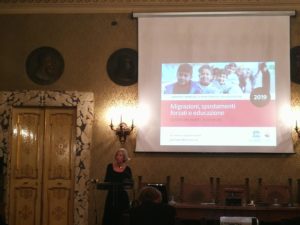 The 2019 GEM report focuses on “presenting evidence on the implication of different types of migration and displacement for education but also the impact that reforming the curricula, pedagogy and teacher preparation can have on embracing diversity,” Stefania Giannini. This report serves as a guide for teachers and governments to determine education objectives for future multicultural generations.
Franco Bernabè opened the discussions claiming that “in order to have social development it is crucial not to build walls but bridges,” rephrasing and broadening the subtitle of the report. The encounter of different cultures is what is needed to increase our societies.
Since our societies are becoming more multicultural, it is fundamental that our teachers are well prepared to communicate and teach children from different backgrounds. It is important to underline that the language used to study and to communicate are not the same.
Indeed, within the 2019 GEM Report are listed seven recommendations, which the main are the following: 1) teachers should receive more support to satisfy the quantity of roles and tasks that they are called to achieve to educate migrants and refugees. 2) Other Italian cities should look at some inclusive activities already established, for example, in Milan and Turin. 3) Governments should insist more on gathering data to estimate better the dimension of migration within their country.
Anna Cristina D’Addio also emphasized the importance of increasing trainings for teachers: “it is relevant that they have the right workflow tools to make these kids, the new generations part of our communities.” Often teachers do not feel supported and well prepared to work in a multicultural environment. According to a survey done in France, Ireland, Italy, Latvia, Spain and United Kingdom, teachers agreed that adjusting the new requests in favor of migrants’ education brought much work and caused frustration due to the lack of support.
The second part of the conference was dedicated to discussions and opened questions. Eugenio Bruno of il Sole 24 Ore, chaired two round tables pointing out interesting arguments around the launching of the report. First, he asked to Fr. Fabio Baggio the Vatican point of view of the situation of migrants’ education, which should be based on the development of centered education. Mario Giro (Former Deputy Minister and Community of Sant ’Egidio), quite surprised, commented that finally UNESCO focused its research not only on the safeguarding of cultural heritage but also on education. Prof. Livi Bacci (University of Florence), on the other hand, introduceed the concepts of the Global Compact and its repercussion on Italian politics. Finally, Prof. Alberto Melloni (UNESCO Chair for Religious Pluralism and Peace), commented that the matter to migration (not an issue) linked to the religious aspects is not well considered in Italy.
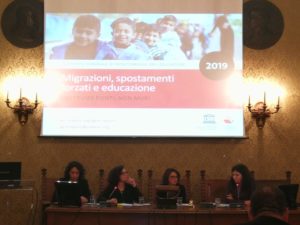
Anna Cristina D’Addio welcomed representatives of international organizations such UNHCR, IOM, and Save the Children in the second round table. Ana de Vega, Paola Alvarez, and Francesca Bocchino discussed the difficulties of accessing the education not only for children but also for adults. Often migrants are collocated in different classes increasing the number of migrants that leave education at early stages. Another factor that pushes away people from education is the bureaucracy and its complex procedures, problems which the 2019 GEM Report is committed to change and improve.
As a UNESCO Chair in Bioethics and Human Rights that promotes bioethical and human rights principles based on the Universal Declaration of Human Rights, it was illuminating being present during the launching of the 2019 GEM Report and contributing with our activities and mission. In this context it is important to underline the constant work that our UNESCO Chair has been doing through the project EUROSOL and CivicAL to improve and understand the nature of migration flow.



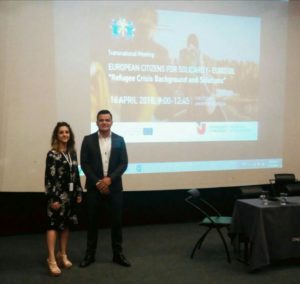 Since last March representatives of these countries along with UK, Bulgaria, Poland, and Lithuania have been gathered to discuss the migrants’ and refugees’ situation within the EUROSOL project funded by the EU.
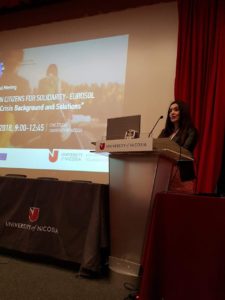 After the introduction and greetings by the Rector of the University and the explanation of the progress of the project by the coordinator Clara Ubeda, the day of discussion developed in four different sessions:
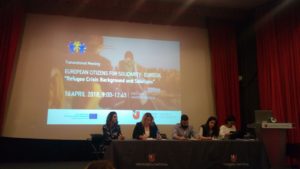 UNESCO Chair collaborator, Serena Montefusco was involved as a moderator in the first round table in which students of the Faculty of Law presented on the principle of non-refoulement. The three students analyzed both the right to asylum and the principle of non-refoulement under the European law. Giving an overview of the laws, protocols, regimes implemented by the EU it was possible to argue how the law is not transparent and distant from the actual reality. In other words, there are many laws that regulated the right to asylum that are not always clear and followed neither in their integrity nor partially. This concept was confirmed by Montefusco when presenting her collaboration with an NGO (
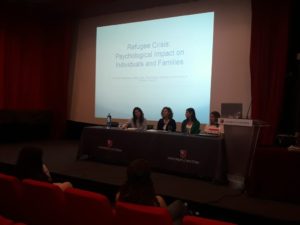 The second round table, moderated by Asya Rafaelova-Eneva of the Altius Francsico d Vitoria Fundation (Spain) and Bistra Choleva-Laleva of BIDA e.V Kultur un Bilding (Germany), one of the eight partners of the EUROSOL projects, analyzed, thanks to the Psychology students, the psychological impact that being an immigrant might cause to individuals and family. Indeed, there are a lot of studies that have seen that these people are affected by PTSD that cause panic attacks, depression, difficulties in maintaining relationships, suicidal thoughts, sleeping problems and others. These students presented three different cases of three Somalian girls who were affected by these symptoms due to the tremendous journey that they take to reconcile with their families in different parts of Europe. In cases of traumas, not only the work of psychologists is fundamental to get through the fears, but also social workers play a crucial role in the process of a successful social inclusion.
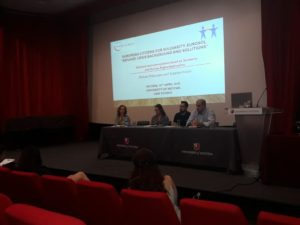 The third round table moderated by the University of Nicosia Research Foundation Director Stefanos Spaneas and Beata Palac, representative of the Poland partner within the EUROSOL project, presented the impressive work and the role of social workers in refugees related matters. Students of the social work program at the University of Nicosia emphasized the importance of values such as freedom, dignity, equity, and solidarity and rights such as the right to education, work and to have a house. Social workers promote the mutual integration among locals and migrants through a multidisciplinary work (psychologist, lawyers, interpreters, …) to ameliorate the migrants’ situation providing them training courses to find better jobs position to give back to society.
 The last session was dedicated to discussing possible solutions and to analyzing some programs that are already implemented and that are better the life of many. Introduced by Dr. Despina Cochliou, the representative of the Erasmus Plus program, the program could share the language courses that the European Union is providing for free. As well known, the knowledge of the local language when one is forced to move to another place is fundamental. Many people in the audience did not know that funds are not only implanted in Cyprus but also in other different countries. Thus, it seems that the European Union needs to improve the way the news is spread. Yet, it is reassuring that there are people that dedicate their lives to this type of work that informs migrants that there are possibilities and accessibility to these programs. Next, Dr. Despina Cochliou introduced an NGO named AWARE (Cyprus) which is a communication and counseling agency which is committed to raise awareness of refugees related matters. They own a constantly updated website and active profiles on social media allowing the share of the latest news and connection among different ethnical groups. The session concluded with the testimony of two refugees that had the possibility to recreate their life in Cyprus. They are both well-educated Syrians, one of whom is working as a leader, mentor and life coaching and the other of whom obtained two bachelor’s degrees in Law Banking and Economics. For privacy reasons, I am not sharing their names, but they serve as an example of a successful social inclusion.
 Serena Montefusco started giving information how institutions are dealing with the great number of migrants arriving in Italy. At the European level, she saw that soft low and funding activities have been implemented to improve the labour market and integration of migrants. For example, in 2016, thanks to the Action Plan on the Integration of the Third Country Nationals and the New Skills Agenda for Europe, it was possible to implement new tools aiming at helping integrate newcomers and local stakeholders assess their qualifications and skills. Moreover, Europe is offering significant funding for labour market integration. Yet, these funds are granted by each Member State and reach cities indirectly. At National level, institutions are responsible for labour law, social security, and active employment policies. Even though decentralized member states, such as Italy, face a formal devolution of responsibilities, the national government sets out an integration plan, objectives, and managing public employment services.